
Most business owners picture cybersecurity as a wall around the company. A firewall here, email filtering there, a password policy everyone signs.
But almost every modern attack ends up in the same place, on a device. A laptop, a desktop, a phone, a tablet, a server in the back room.
These devices are called endpoints, and they are where the real work happens, where your data lives or is accessed, and where attackers most want to be. If your endpoints are not secured, patched, and monitored, the rest of your security stack matters far less than you would hope.
That is why endpoint security is not just another item on a checklist. It is the foundation everything else stands on.
What Is Endpoint Security?
An endpoint is any device that connects to your business systems. Laptops, desktops, phones, tablets, and servers are all endpoints, and each one is a door into your business.
Endpoint security is the practice of protecting those devices so they cannot be used to break in, steal data, or spread an attack. Done well, it does four things at once. It prevents threats from running in the first place. It detects suspicious behavior when something slips through. It responds fast enough to contain a device before the problem spreads. And it keeps every device patched, configured, and visible to the people responsible for it.
Years ago this mostly meant antivirus software that scanned for known bad files. That is no longer enough. Many of today’s threats have no file to scan, change their code constantly to avoid detection, or arrive through tools that look completely legitimate. Modern endpoint protection watches how a device actually behaves rather than only what is sitting on the hard drive, and it can isolate a device the moment that device starts acting like it has been compromised.
Why Endpoints Are the Foundation, Not Just a Layer
What many owners miss is that almost every other security control they rely on ultimately depends on the endpoint being trustworthy.
Your email security filters a malicious message, but the link still opens on a device. Your identity controls verify a login, but the session runs on a device. Your cloud apps protect your files, but people reach them from a device. If the laptop in someone’s hands is already compromised, the attacker is effectively inside all of it.
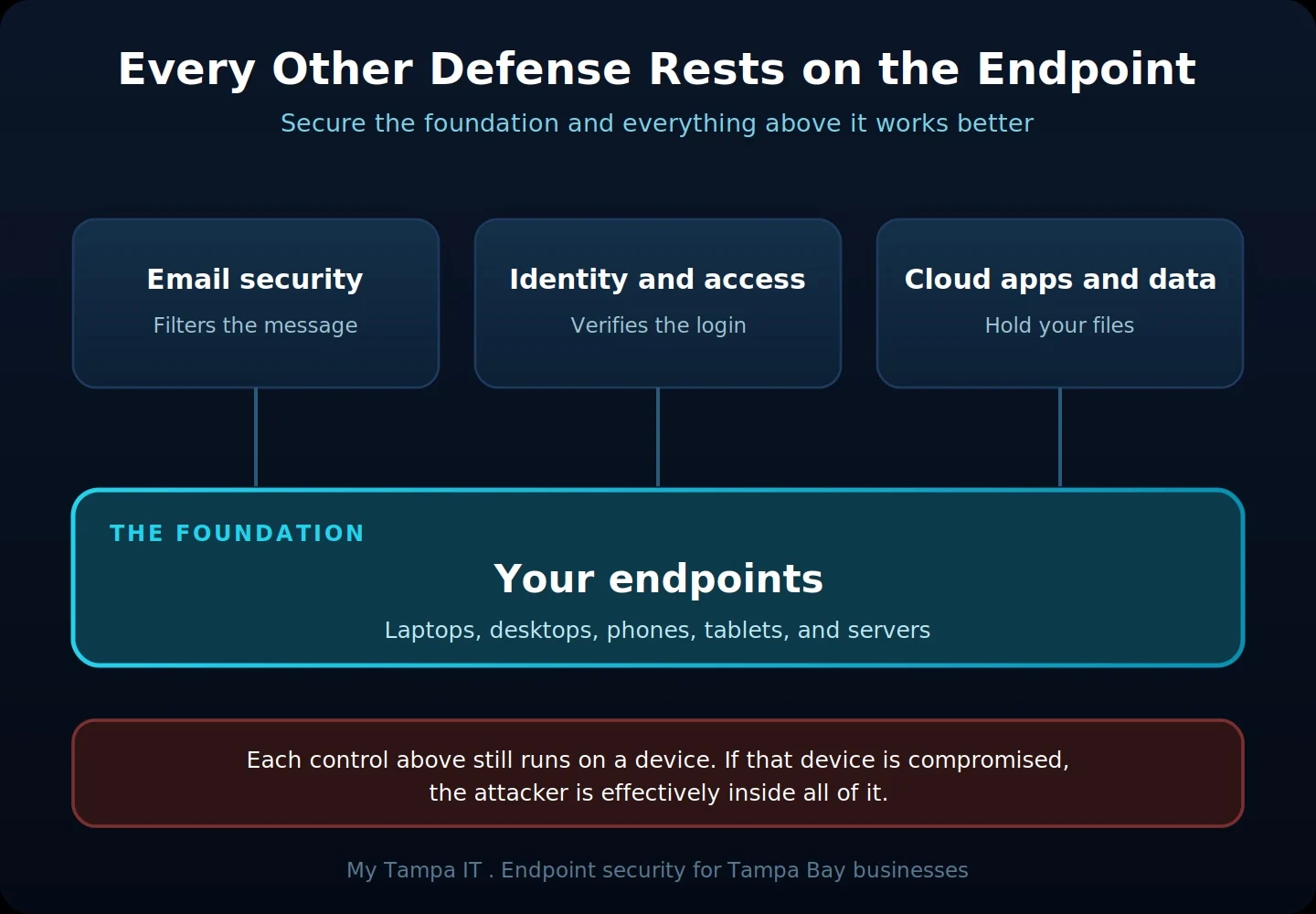
That is why modern attacks so often begin at the endpoint. It is the place where a person clicks, downloads, signs in, and trusts. And once an attacker gains a foothold on one device, speed works in their favor. Threat research in 2026 shows attackers moving from a single compromised device to the rest of the network in minutes rather than days. If that first device is not monitored, no one notices until the damage is done.
Endpoints Are Now One of the Most Targeted Surfaces
Part of what changed is simply where work happens. A decade ago, most devices sat inside one office, behind one network, easy to see and easy to manage.
Today your team works from home, from client sites, from the road, and from personal devices, all of them touching cloud systems that live outside any office wall. That flexibility is good for business, but it also means your devices are more scattered than ever, and scattered devices are harder to see. As visibility drops, risk rises, because you cannot protect or respond to what you cannot see. For a small or mid-sized business without a full-time IT team, that gap tends to widen unnoticed until something breaks.
The 2026 Shift From Vulnerabilities to Trust
For years, breaking in meant finding a technical hole. An unpatched server, a weak password, a software flaw. That still happens, but the larger shift in 2026 is that attackers have realized it is often easier to target trust than to hunt for a vulnerability. This is also why more businesses are moving toward zero trust security.
Rather than breaking down the door, they get someone to open it. Threat research this year found that a striking majority of detected attacks involved no malware at all, relying instead on stolen logins, legitimate software, and trusted access to blend in with ordinary activity.
The newest version of this aims at the sources people trust most, search results and the answers from AI assistants. Attackers poison search rankings and even AI-generated answers so that an employee looking for a routine software download, or simply asking an AI tool where to find it, is steered toward an attacker-controlled copy. Microsoft has documented this happening. The person was not hacked in any traditional sense. They trusted the result, clicked, and installed the problem themselves.
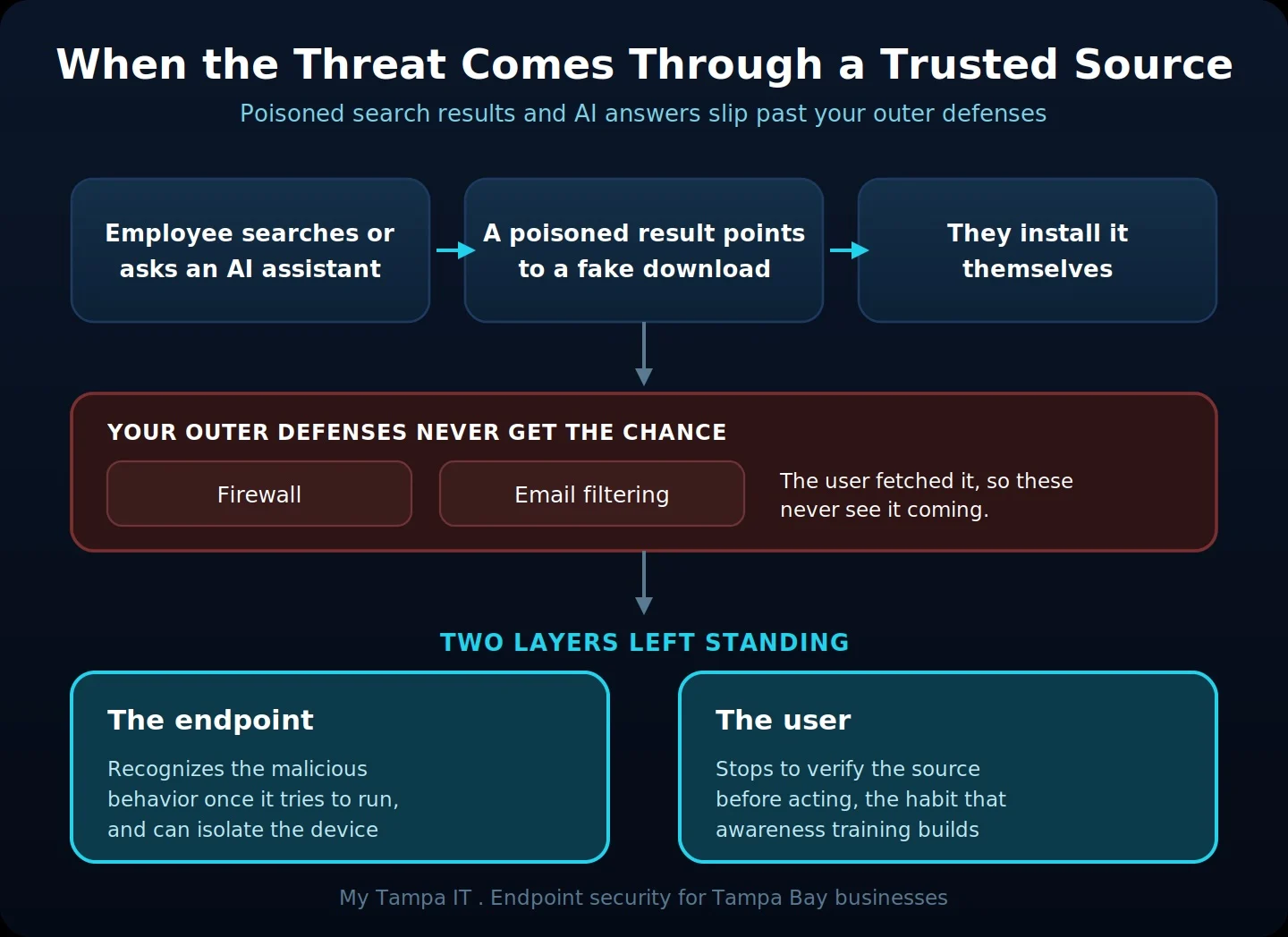
That is what makes the tactic so effective. When the user is the one who goes and fetches the threat because a trusted source pointed them to it, your perimeter and your email filters never get the chance to catch it. Two layers are left standing. The first is the endpoint, which can recognize the malicious behavior once it tries to run. The second is the user, who can stop and verify a source before acting on it. This is exactly why endpoint protection and user awareness matter more now than they ever have. They are the layers built to catch what a trust-based attack is designed to slip past.
What Strong Endpoint Security Actually Includes
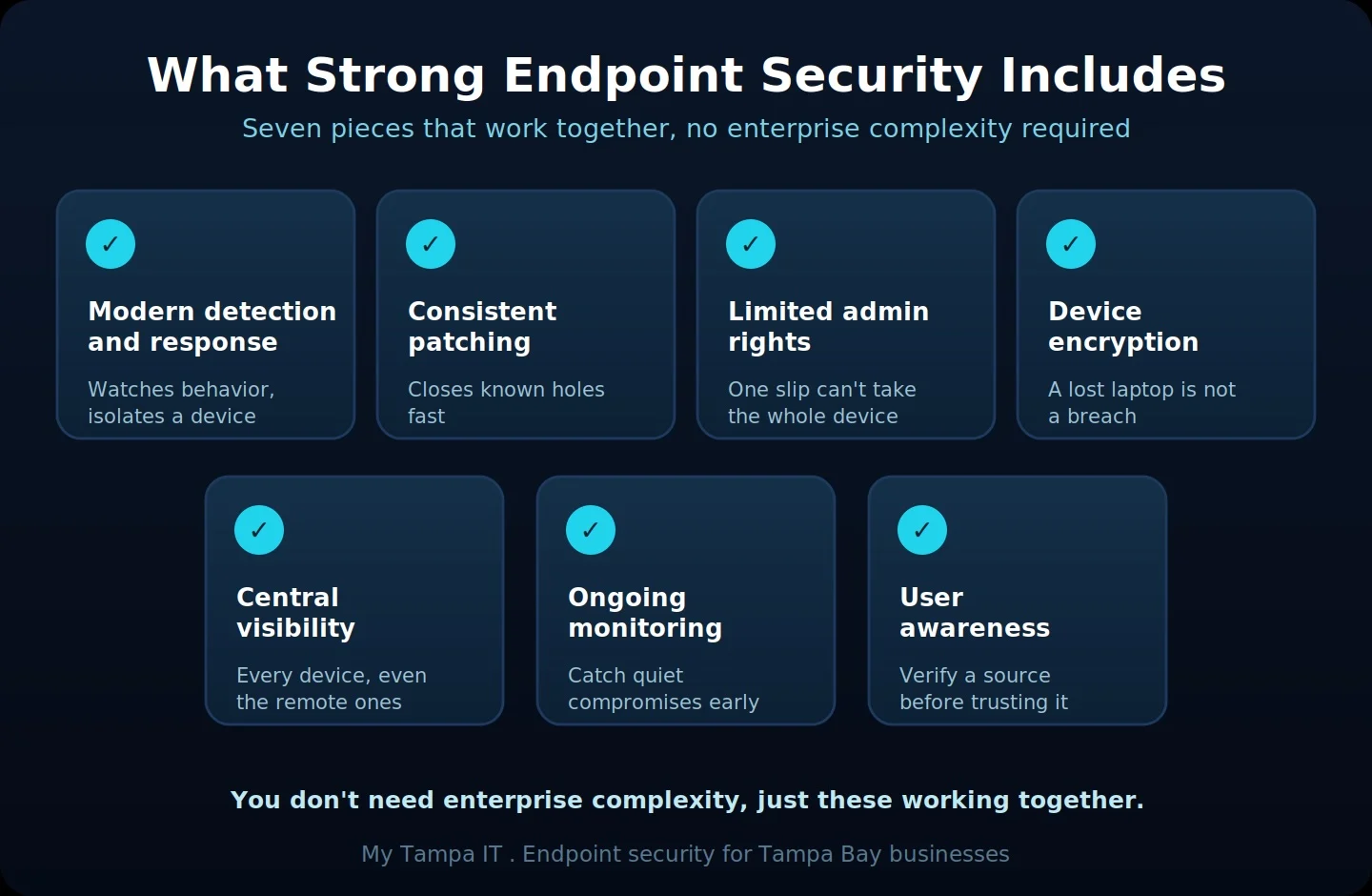
You do not need enterprise complexity to get this right. A solid foundation for a small or mid-sized business comes down to a handful of things that work together.
- Modern endpoint detection and response that watches behavior and can isolate a device, rather than legacy antivirus alone
- Consistent patching and updates, so known holes close quickly
- Proper configuration and limited administrator rights, so a single mistake does not surrender the whole device
- Device encryption, so a lost or stolen laptop does not become a data breach
- Centralized visibility across every device, including the ones working remotely
- Ongoing monitoring, so a quiet compromise is caught early instead of weeks later
- Practical user awareness, so people know not to trust a search result or an AI answer blindly
The goal is not to lock everything down until work becomes painful. The goal is to make sure the devices your business runs on cannot be quietly turned against you.
Why This Matters for Tampa Bay Businesses
Most Tampa Bay businesses now run on a mix of laptops, mobile devices, and cloud tools, often with people working in more than one location. That is normal and healthy. It also means the old picture of security as a wall around the office no longer matches how anyone actually works.
The businesses that handle this well are not the ones with the biggest budgets. They are the ones that treat their devices as the foundation, secured, patched, monitored, and backed by a team that can spot a problem and act on it quickly. In a community built on referrals and reputation, that kind of reliability is part of how you keep your clients’ trust.
The Bottom Line
You can invest in every security tool on the market, but if your endpoints are not secured, patched, and monitored, you have built your defenses on sand. Endpoints are where modern attacks land, and they are where those attacks can be stopped. Get the foundation right and everything else you do works better for it.
Ready to Strengthen Your Foundation?
At My Tampa IT, we help Tampa Bay businesses secure the devices their work actually runs on, with modern endpoint protection, patching, monitoring, and practical guidance your team can follow. We do not just hand you a tool and walk away. We help you understand where your real risks are, and we keep watch as the threat landscape changes.
If you want a clear picture of how protected your endpoints are today, let’s talk. Contact us to review where your foundation stands.
Frequently Asked Questions
Start by taking stock of what you have. List every device that touches your business, then ask whether each one is protected with modern endpoint detection, whether it is being patched, and whether anyone is actually watching it for trouble. If you cannot answer those questions with confidence, that is the gap to close first, and it is exactly the kind of review we can walk through with you.
It means the threat increasingly arrives through something your employee already trusts, a login, a familiar tool, a top search result, or an answer from an AI assistant. Attackers poison those sources so that a normal action like downloading software quietly delivers an attack. Your defense is a combination of endpoints that can catch the bad behavior and employees who know to verify a source before they act on it.
Yes, and arguably more than a single-office business does. Remote and hybrid work spread your devices across homes, client sites, and personal hardware, which makes them harder to see and protect. Endpoint security gives you centralized visibility and protection no matter where a device is working from.
Not anymore. Traditional antivirus looks for known bad files, but many of today’s attacks have no file to find, change their code to avoid detection, or arrive through legitimate-looking tools. Modern endpoint detection and response watches how a device behaves and can stop and isolate a threat even when it has never been seen before.
Any device that connects to your business systems. That includes laptops, desktops, phones, tablets, and servers, along with the personal devices employees use for work. Each one is a potential entry point, which is why each one needs protection.
Get In Touch!
You’ve got questions. We’ve got answers.
Let’s start the conversation about your IT support needs.