AI is already showing up inside most businesses, whether leadership realizes it or not – and the companies here in Tampa Bay are no exception.
Employees may be using ChatGPT, Microsoft Copilot, Claude, Gemini, Grok, or AI features built into everyday software. They may be using these tools to write emails, summarize documents, review spreadsheets, create marketing content, troubleshoot problems, or speed up repetitive work.
Used the right way, AI can be a real advantage.
Used without guardrails, it can create security, privacy, compliance, and business risk. Many of those risks are ones most business owners don’t know about, which is exactly why guardrails matter.
That is why every organization needs an AI policy.
An AI policy does not have to be complicated. It simply needs to give your team clear rules for how AI can be used, what information must be protected, who is responsible for oversight, and what tools are approved.
What Is an AI Policy?
An AI policy is a set of rules that guides how your company uses artificial intelligence.
It should explain:
- What AI tools employees are allowed to use
- What information can and cannot be entered into AI tools
- Who reviews AI-generated work before it is used
- How AI tools are approved
- How your company protects sensitive data
- What employees should do if they are unsure
The goal is not to stop people from using AI. The goal is to help them use it safely.
Without clear guidance, employees are left to make their own decisions. That can lead to sensitive information being pasted into public AI tools, unapproved apps being used for business tasks, or AI-generated answers being trusted without review.
The 3 Layers of AI Policy
There are three layers every organization should understand. They nest inside one another as follows: the outside world’s rules, then your industry’s expectations, then the policy you control. Most businesses should start from the inside out.
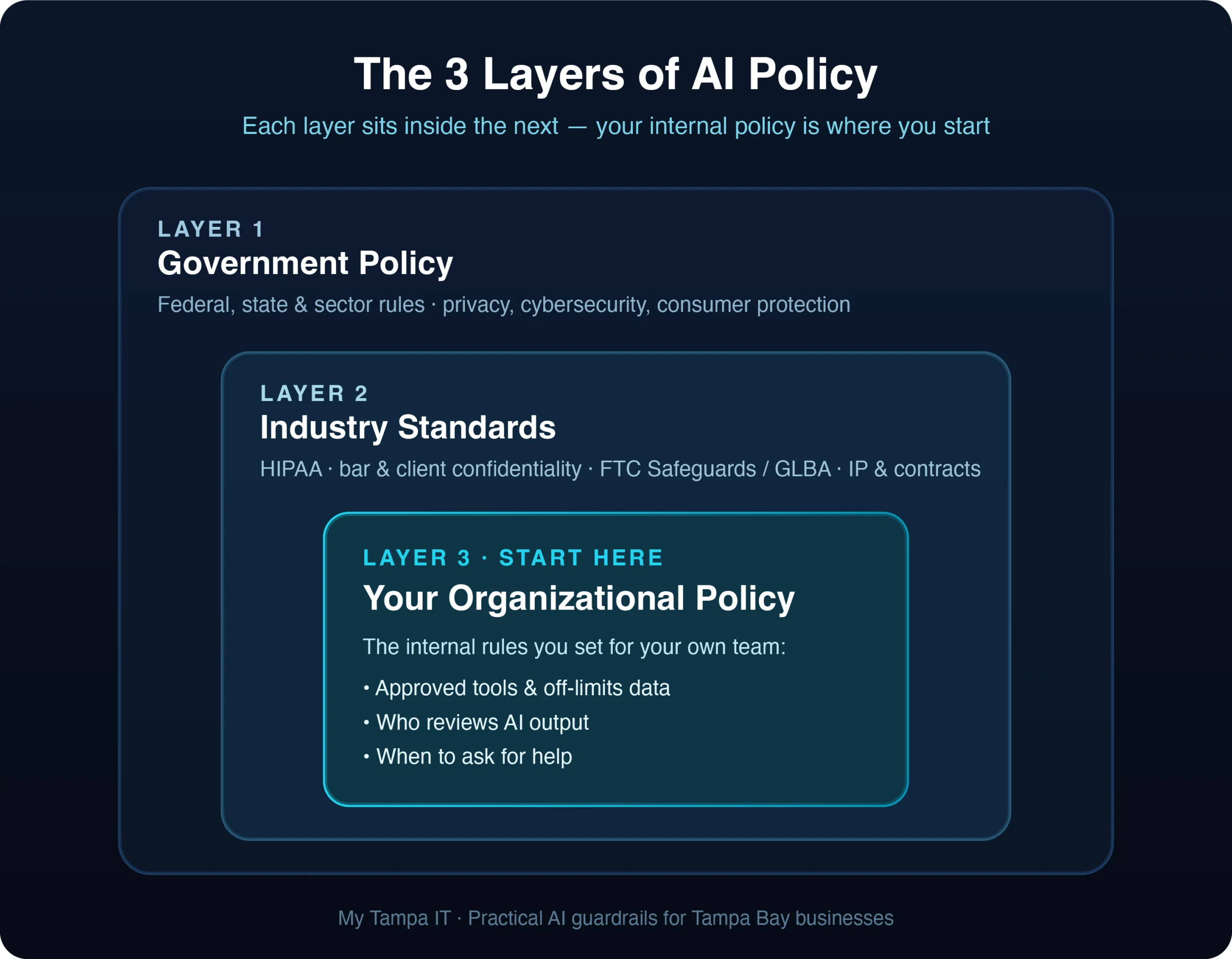
Layer 1: Government Policy
Government policy includes federal, state, and international rules related to AI, privacy, cybersecurity, consumer protection, and regulated data.
In the United States, there is not one single AI law that covers every business. Instead, AI oversight comes from several different areas, including privacy laws, cybersecurity requirements, industry regulations, and consumer protection enforcement.
For businesses, this means AI risk cannot be viewed in isolation. It connects directly to data privacy, cybersecurity, compliance, vendor management, and employee training.
Layer 2: Industry Standards
Some industries have additional expectations because of the type of data they handle.
- Healthcare organizations need to think about HIPAA and protected health information.
- Financial firms need to think about client data, records, disclosures, and regulatory expectations.
- Law firms need to protect confidential client information.
- Accounting firms need to protect tax records, financial statements, and personally identifiable information.
- Construction, engineering, and professional service firms need to protect contracts, plans, intellectual property, and client data.
Even if AI rules are still evolving, your existing security and compliance obligations still apply.
Layer 3: Your Organizational Policy (Start Here)
This is the internal AI policy your business creates for your own team. It is the layer closest to you, the one you fully control, and for most small and mid-sized businesses it is the most urgent place to start.
Your organizational AI policy should answer practical questions, such as:
- Can employees use public AI tools for work?
- Can they upload files?
- Can they enter client information?
- Can they use AI to create client-facing content?
- Who approves new AI tools?
- Who is responsible for reviewing AI output?
- What should employees do before following technical advice from AI?
This is where businesses can reduce risk quickly by setting clear rules and expectations.
The U.S. AI Oversight Landscape
AI oversight in the United States is spread across several agencies and regulatory bodies. For business owners, the important point is simple: AI risk is being watched more closely.
Several agencies play a role.
- NIST provides guidance and risk management frameworks that many organizations use as a practical standard.
- The FTC focuses on consumer protection, deceptive claims, unfair business practices, and misuse of data.
- CISA provides cybersecurity guidance, especially around critical infrastructure and security risk.
- Industry regulators, such as those in healthcare, financial services, and other regulated sectors, may also set expectations for how AI is used.
This can feel confusing because there is no single AI rulebook. But the direction is clear.
The rules are also moving quickly. In early 2026, the White House released a national AI policy framework urging Congress to move toward a single federal standard, several states put their own AI laws into effect on January 1, 2026, and there is an active push to have federal rules override some state ones. For most Tampa Bay businesses, the practical takeaway has not changed: there is still no single federal AI law to point to, so your obligations come from a mix of privacy rules, cybersecurity expectations, and your industry’s existing requirements… and that mix is getting more attention, not less.
Florida does not have a standalone AI law of its own yet, but that does not get local businesses off the hook. Federal privacy and cybersecurity expectations, along with your industry’s rules, still apply.
Put simply, businesses are expected to know where AI is being used, protect sensitive data, manage vendor risk, and make sure AI does not create unfair, unsafe, or unexplainable outcomes.
The 4 Pillars of a Strong AI Policy
A strong AI policy should be built around four core pillars.
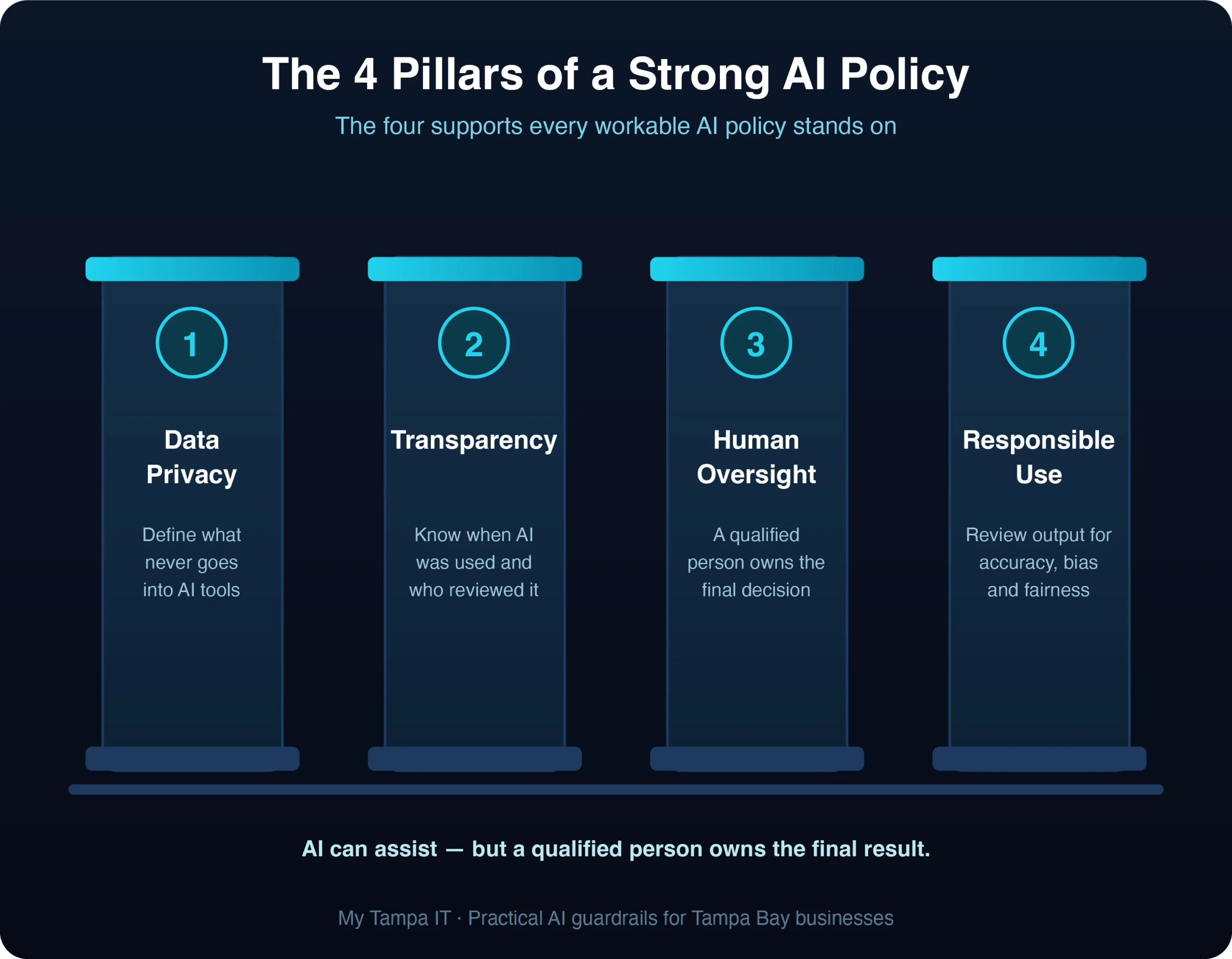
Pillar 1: Data Privacy
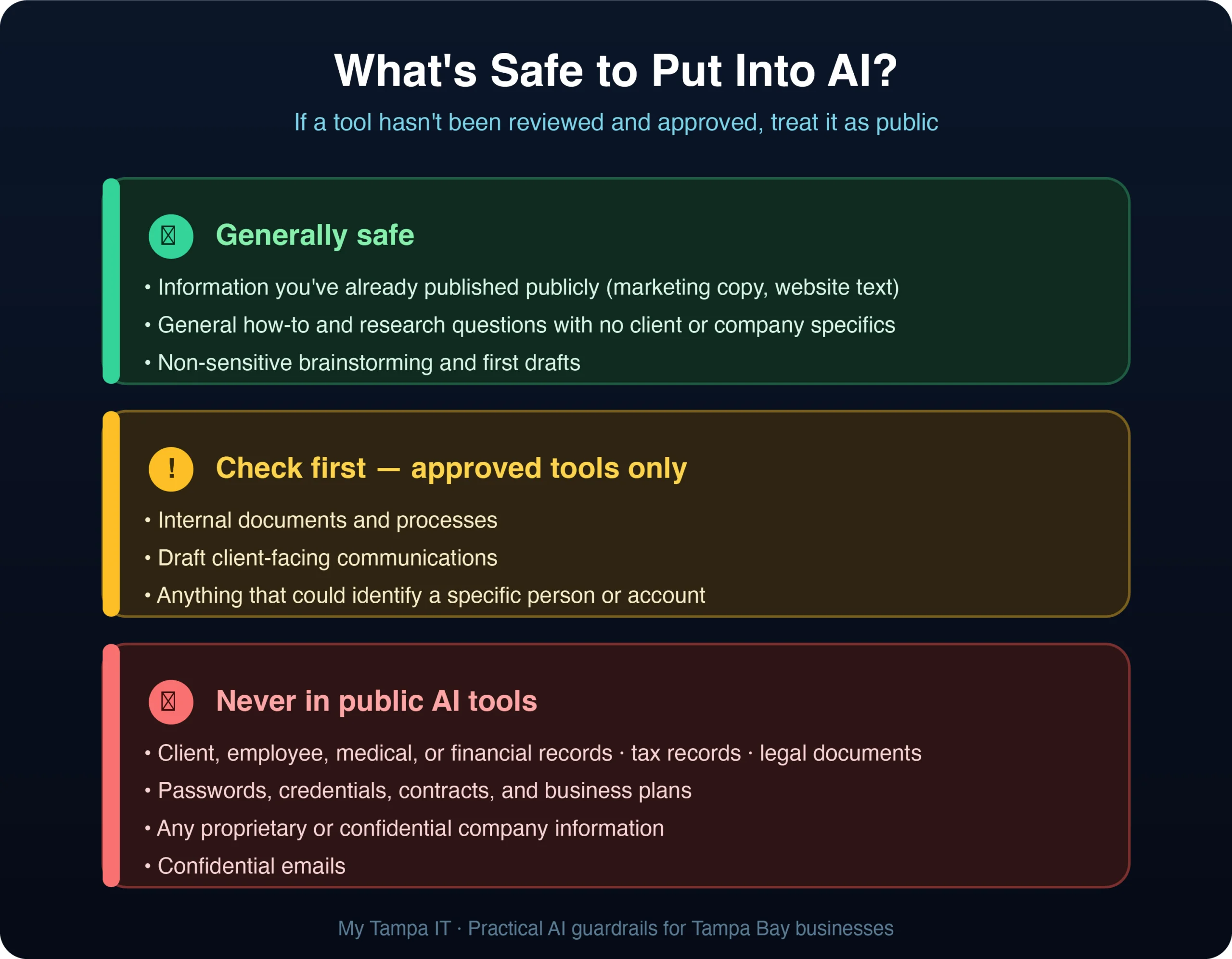
Your policy should clearly define what information employees are not allowed to enter into AI tools. A simple way to think about it: if a tool has not been reviewed for privacy, security, and business use, treat it as public.
Sensitive data should never be entered into unapproved AI tools. When in doubt, employees should assume a tool is not safe for confidential information and ask before using it.
Pillar 2: Transparency
AI-generated work should not be treated as automatically correct.
Employees need to understand when AI was used, what it was used for, and whether the final output was reviewed by a person.
This is especially important for client-facing communications, financial decisions, HR matters, legal content, compliance work, and cybersecurity recommendations.
AI can help create drafts and speed up research, but someone still needs to verify the information and take responsibility for the final result.
Pillar 3: Human Oversight
AI should support decision-making, not replace judgment in high-risk areas.
Your policy should define when human review is required. This may include decisions involving hiring, employee performance, client recommendations, financial matters, security changes, or anything that could create legal or compliance exposure.
A simple rule works well: AI can assist, but a qualified person owns the final decision.
Pillar 4: Bias Prevention and Responsible Use
AI can produce biased, incomplete, or inaccurate results. It can also make assumptions that are not obvious unless someone reviews the output carefully.
Your policy should require employees to review AI-generated content for accuracy, fairness, tone, and potential risk before using it.
This is especially important when AI is used for hiring, customer communications, marketing, financial recommendations, or anything involving people, eligibility, access, or opportunity.
AI Compliance: What Organizations Should Track
AI compliance is not just about having a written policy. Businesses also need documentation and controls that show the policy is actually being followed.
Organizations should track:
- Approved AI tools
- Who has access to those tools
- What data those tools can access
- Vendor security reviews
- Employee training
- AI-related incidents or concerns
- Policy exceptions
- System logs and activity where appropriate
- Testing or review of AI output in higher-risk areas
This matters because written policies alone do not reduce risk. The business needs a way to prove that AI is being managed responsibly.
Vendor and Third-Party AI Risk
Many AI risks come from vendor tools, not tools your company built internally.
AI is now being added into CRMs, accounting platforms, marketing tools, phone systems, help desk platforms, cybersecurity tools, HR systems, and Microsoft 365 applications.
Before approving an AI-enabled vendor, businesses should ask:
- What data does the tool access?
- Where is the data stored?
- Is our data used to train AI models?
- Can AI features be turned off or limited?
- What security controls are available?
- Does the vendor support multi-factor authentication?
- Can access be controlled by role?
- Does the vendor meet our compliance requirements?
- What happens to our data if we leave the platform?
Vendor risk matters because your business is still responsible for protecting client and company data, even when that data is handled by a third-party tool.
The Role of IT in AI Policy
AI policy cannot live only in a document. IT plays a key role in making sure the policy can actually be enforced.
That may include:
- Approving AI tools before use
- Managing access controls
- Securing Microsoft 365 and Copilot settings
- Monitoring for risky activity
- Blocking unsafe apps or browser extensions
- Protecting sensitive data
- Reviewing vendor security
- Training employees
- Maintaining logs and documentation
- Responding to AI-related security concerns
This is where many small and mid-sized businesses need help. They may know they need an AI policy, but they do not have the internal resources to review tools, configure controls, monitor risk, and train employees properly.
How My Tampa IT Helps Businesses Use AI Safely
AI can be a powerful tool, but it needs the right guardrails.
My Tampa IT helps businesses put practical AI policies, security controls, and employee training in place so they can use AI with confidence.
We help with:
- AI readiness assessments
- AI acceptable use policies
- Microsoft 365 and Copilot security readiness
- Vendor and AI tool review
- Cybersecurity controls
- Employee training
- Data protection
- Monitoring and risk reduction
The goal is not to scare businesses away from AI. The goal is to help them use it wisely, securely, and in a way that protects the company, its clients, and its data.
If your team is already using AI, now is the time to make sure it is being used safely.
Schedule a consultation with My Tampa IT to talk through your AI risks, policies, and the guardrails your business needs.
Frequently Asked Questions
The biggest risk is that AI use grows quietly inside your business with no oversight.
That can lead to confidential data exposure, poor decisions based on inaccurate AI output, compliance issues, vendor risk, and security gaps.
It can also create problems with clients if they expect their data to be handled securely and your business cannot clearly explain how AI is being managed.
AI ethics is about broader principles, such as fairness, responsibility, and transparency.
AI policy turns those ideas into actual rules your business can follow and enforce.
For example, “protect client data” is an ethical principle. “Employees may not enter client financial records into public AI tools” is a policy.
At least once a year.
You should also review it when your business adds new AI tools, changes software platforms, experiences a security incident, faces new compliance requirements, or starts using AI in a more sensitive area of the business.
They can, but it creates risk.
At minimum, businesses should create basic acceptable use rules before employees use AI for work. Even a short interim policy is better than leaving employees to make their own judgment calls.
Yes. If your employees are using AI tools for work, your business needs at least a basic AI policy.
It does not have to be a 40-page legal document. A simple, clear policy is often the best place to start. The policy should explain what tools are approved, what data is off limits, and when employees should ask for help.
Get In Touch!
You’ve got questions. We’ve got answers.
Let’s start the conversation about your IT support needs.