
Your team is probably already using AI. Someone is drafting proposals with it, summarizing long email threads, cleaning up spreadsheets, or answering customer questions faster than ever. That is a good thing. It also quietly changes your risk picture, because the same tools that save your people hours can leak sensitive information, be tricked into bad behavior, or be fed poisoned data without anyone noticing.
The good news is that you do not have to invent a plan from scratch. The National Institute of Standards and Technology, better known as NIST, has done the heavy lifting. NIST is the same trusted authority behind the cybersecurity guidance that banks, hospitals, and government agencies already follow. Now they have turned that same clear-eyed attention to AI. This is a plain-language walk through what NIST says about AI security threats and, more importantly, the controls that keep your business on the safe side of them.
Why AI Deserves Its Own Security Conversation
Traditional security assumes an attacker is trying to break in from the outside. AI adds a second front. The threat is not only someone stealing your data but someone manipulating the tool itself, so it makes decisions you never intended. An AI assistant that reads your documents, drafts your emails, and pulls from your files has real reach inside your business. If it can be nudged in the wrong direction, that reach becomes a liability.
In March 2025, NIST published an updated report titled Adversarial Machine Learning, a Taxonomy and Terminology of Attacks and Mitigations, cataloged as NIST AI 100-2e2025. It is one of the most useful public resources for understanding how AI systems can be attacked and what can reduce the danger. You do not need to read all of it. That is our job. Here is what matters for a business owner.
The AI Threats NIST Wants You to Understand
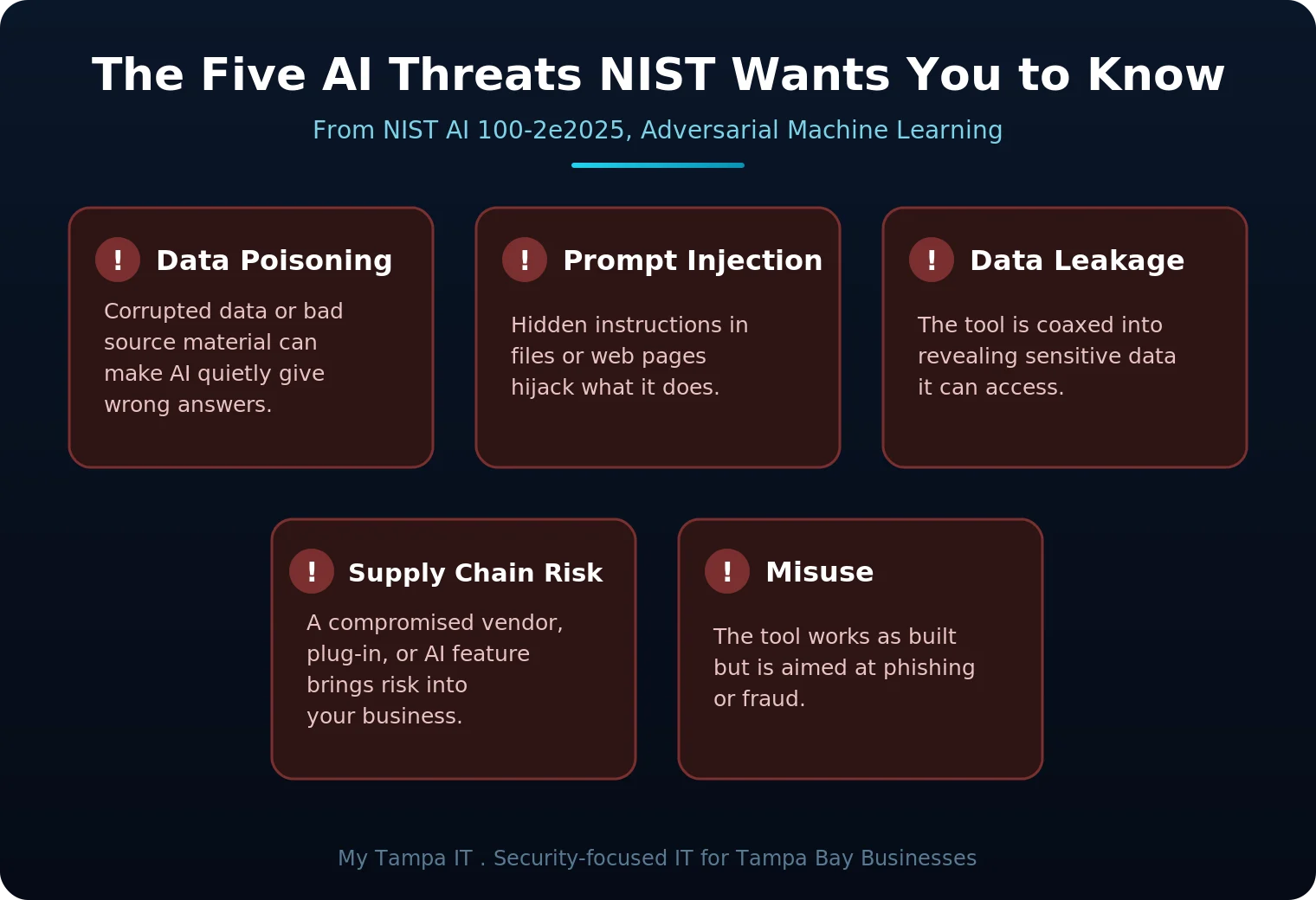
NIST groups AI attacks into a handful of plain ideas. Once you see them named, you start to recognize where your own exposure lives.
The first is data poisoning. This happens when an attacker corrupts the information an AI system learns from or draws on, so its answers become subtly or badly wrong. Think of it as slipping bad ingredients into the recipe before the meal is ever cooked.
The second is prompt injection, which NIST splits into two forms. Direct prompt injection is when someone types instructions that trick the tool into ignoring its rules. Indirect prompt injection is sneakier and more relevant to everyday work. An attacker hides malicious instructions inside a document, a web page, an email, or a calendar invite that your AI assistant later reads and acts on. The employee did nothing wrong. The AI simply followed a hidden command buried in content it was asked to process.
The third is data leakage and privacy attacks. AI tools can be coaxed into revealing the sensitive information they were trained on or given access to, including customer records, financials, or confidential files.
The fourth is supply chain risk. Most businesses use AI features built by outside vendors. If one of those vendors, models, or plug-ins is compromised, the weakness rides straight into your environment.
The last is plain misuse, where the tool works exactly as designed but gets pointed at something harmful, like generating convincing phishing messages or fraudulent content.
How to Think About Controls the NIST Way
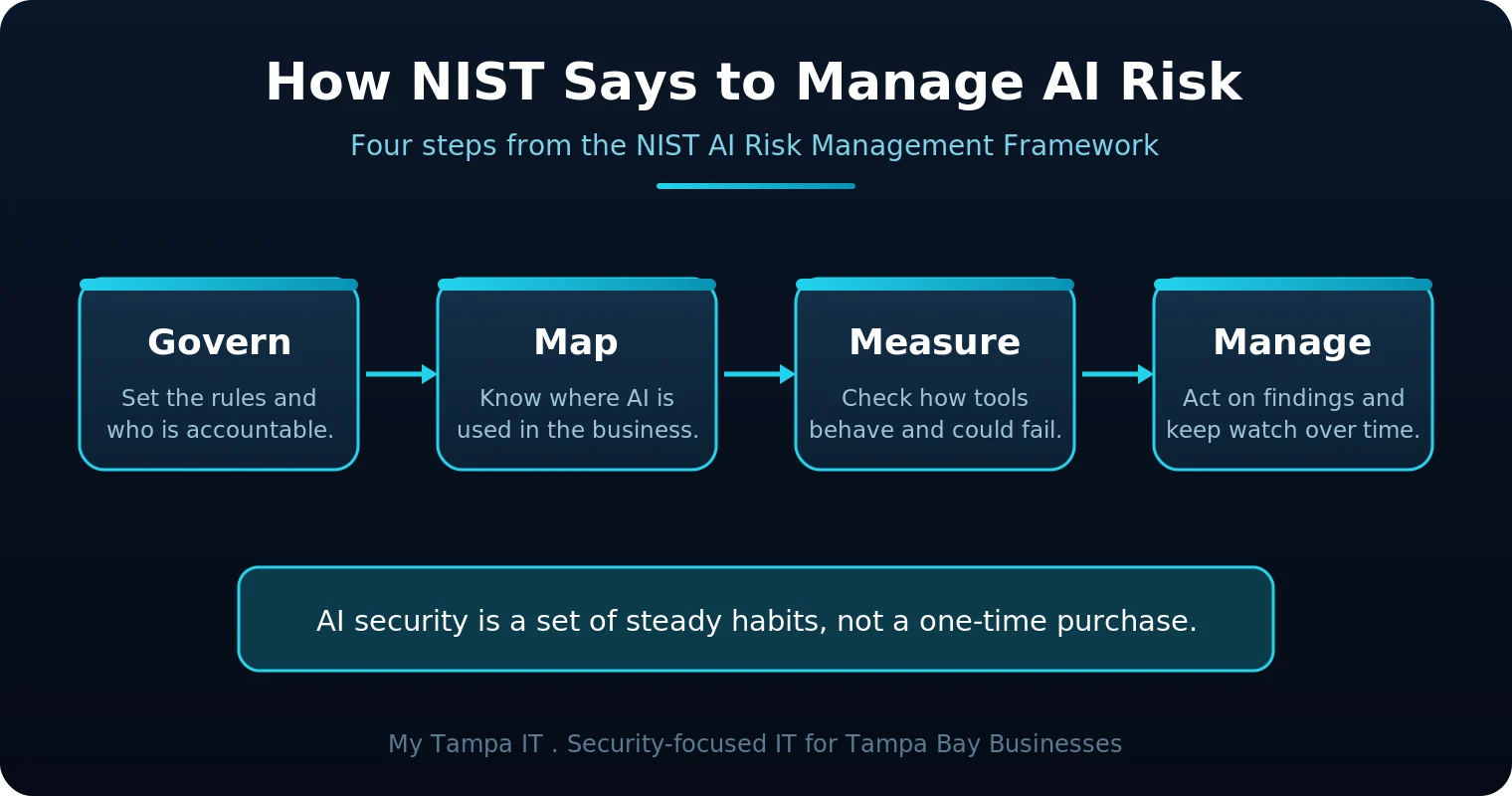
NIST also publishes the AI Risk Management Framework, a companion approach for keeping AI trustworthy. It organizes the work into four simple functions that any owner can follow. Govern means setting the rules and deciding who is accountable. Map means knowing where AI is actually used across your business, which is usually more places than leaders expect. Measure means checking how the tools behave and where they could go wrong. Manage means acting on what you find and keeping watch over time.
The value here is the mindset. AI security is not a single product you buy once. It is a small set of habits, applied consistently, the same way you already lock the doors and back up your files.
Practical Controls That Fit a Small Business
You do not need a research lab to apply what NIST recommends. The controls that matter most for a small or mid-sized business are practical and achievable.
- Write a short AI use policy so your team knows which tools are approved and what information should never be pasted into them.
- Limit what each AI tool can reach, so an assistant only sees the data that role genuinely needs, not the whole company drive.
- Keep a human in the loop for decisions that carry money, legal, or safety weight, rather than letting the tool act on its own.
- Vet your vendors and ask how they secure their AI features, handle your data, and respond to problems.
- Train your people to recognize that a document or link can carry hidden instructions, not just malware.
- Turn on monitoring, logging, and alerts where available, especially for AI tools connected to email, files, customer data, or financial workflows.
- Keep a simple inventory of approved AI tools, who uses them, what data they can access, and whether they are connected to company systems.
None of these require deep technical skill to decide on. They do require someone to own them and keep them current, which is where a trusted partner earns their keep.
A Note for Regulated Businesses
If you work in a regulated field, AI raises the stakes. Healthcare practices handling protected health information have HIPAA obligations that follow that data into any AI tool. Law firms carry client confidentiality duties under state bar rules and ABA Model Rule 1.6, which do not pause because a convenient assistant is involved. Many financial services firms, tax preparers, and accounting firms may also have obligations under the FTC Safeguards Rule and GLBA. Feeding regulated data into an AI tool that has not been vetted can turn a productivity boost into a compliance problem. Before your team adopts a new tool, it is worth confirming it fits the rules your business already lives by.
How We Help at My Tampa IT
Keeping AI safe is a natural extension of the security work we already do for the businesses we support across Tampa Bay. We help you find where AI is being used, set sensible guardrails, tighten what each tool can access, and watch for the unusual activity that signals trouble. Because we treat this as an ongoing service rather than a one-time project, your protections keep pace as the tools evolve and as your team finds new ways to use them. Our goal is simple. We want you to get the real benefits of AI with confidence, not caution born from uncertainty. If you want a clearer view of where you stand, our team can walk your business through it in plain language and help you build the habits that keep you protected.
Ready to Use AI With Confidence
AI may be one of the biggest opportunities your business has seen in years, and it deserves the same steady, thoughtful protection you already give the rest of your operation. If you would like help putting sensible AI security controls in place, reach out to My Tampa IT. We will help you move forward with clarity and confidence, and we are proud to be a trusted neighbor to the Tampa Bay businesses we serve.
Frequently Asked Questions
Start by mapping where AI is actually used and what each tool can access. If you are not sure, that uncertainty is the risk. A short assessment gives you a clear picture and a prioritized list of what to fix first.
It is a trick where hidden instructions are planted in content your AI tool reads, like a document or a web page, so the tool quietly does something it should not. The employee never sees it happen, which is what makes it dangerous.
You are not legally required to, but it is the clearest roadmap available and it is free. Following NIST also helps you meet the security expectations that clients, insurers, and regulators increasingly ask about.
Write down which AI tools are approved and what information should never go into them, then make sure your team has seen it. Most AI incidents start with a well-meaning employee pasting sensitive data into a tool nobody vetted.
It can be, with a few guardrails in place. The risk comes from using tools without knowing what data they touch or where that data goes. A short written policy, sensible access limits, and a little training turn AI from a worry into an advantage.
Get In Touch!
You’ve got questions. We’ve got answers.
Let’s start the conversation about your IT support needs.