
CPA firms hold some of the most sensitive information a business can have.
Tax returns. Social Security numbers. Bank account details. Payroll records. Financial statements. Client communications. Years of private financial history.
That makes CPA firms a high-value target for cybercriminals.
A single breach can expose the financial lives of hundreds or even thousands of clients. It can also damage the firm’s reputation, create legal and compliance issues, disrupt operations during tax season, and put client trust at risk.
Cybersecurity is no longer just an IT issue for accounting firms. It is a business risk, a compliance issue, and a client trust issue.
The good news is that most of the common attacks can be reduced with the right security controls, employee training, monitoring, and proactive IT support.
In this guide: why CPA firms are targeted, how a single click turns into a full breach, the 7 risks to watch in 2026, the emerging threats changing the game (AI phishing, deepfakes), the protections that actually stop them, and what the IRS and FTC now require of every preparer.
Why CPA Firms Are a Prime Target
Cybercriminals go where the valuable data is.
CPA firms are attractive targets because they often store complete financial profiles for their clients. That may include tax records, income details, business financials, bank information, personally identifiable information, and login credentials for financial systems.
Attackers also know that CPA firms operate under deadline pressure. Tax season, year-end close, extension deadlines, and filing deadlines all create busy windows where employees are moving quickly. When people are overwhelmed, they are more likely to click a bad link, trust a fake request, or skip a verification step.
That is exactly what attackers count on.
CPA firms also have trusted relationships with their clients. If a client receives an email that appears to come from their accountant asking for a document, a signature, or updated banking information, they may respond quickly because the request feels normal. That trust is valuable, and cybercriminals know how to exploit it.
How One Click Can Turn Into a Full CPA Firm Breach
Most cyberattacks do not start with some dramatic technical event. They often start with one believable email.
A fake IRS notice. A spoofed client message. A vendor alert. A document request that looks routine during tax season.
An employee clicks the link, opens the attachment, enters credentials, or replies with information. From there, the attacker may gain access to email, cloud applications, tax files, client records, or banking details. Once inside, they can move quietly, reading emails, studying client relationships, stealing documents, changing payment instructions, or preparing for a ransomware attack.
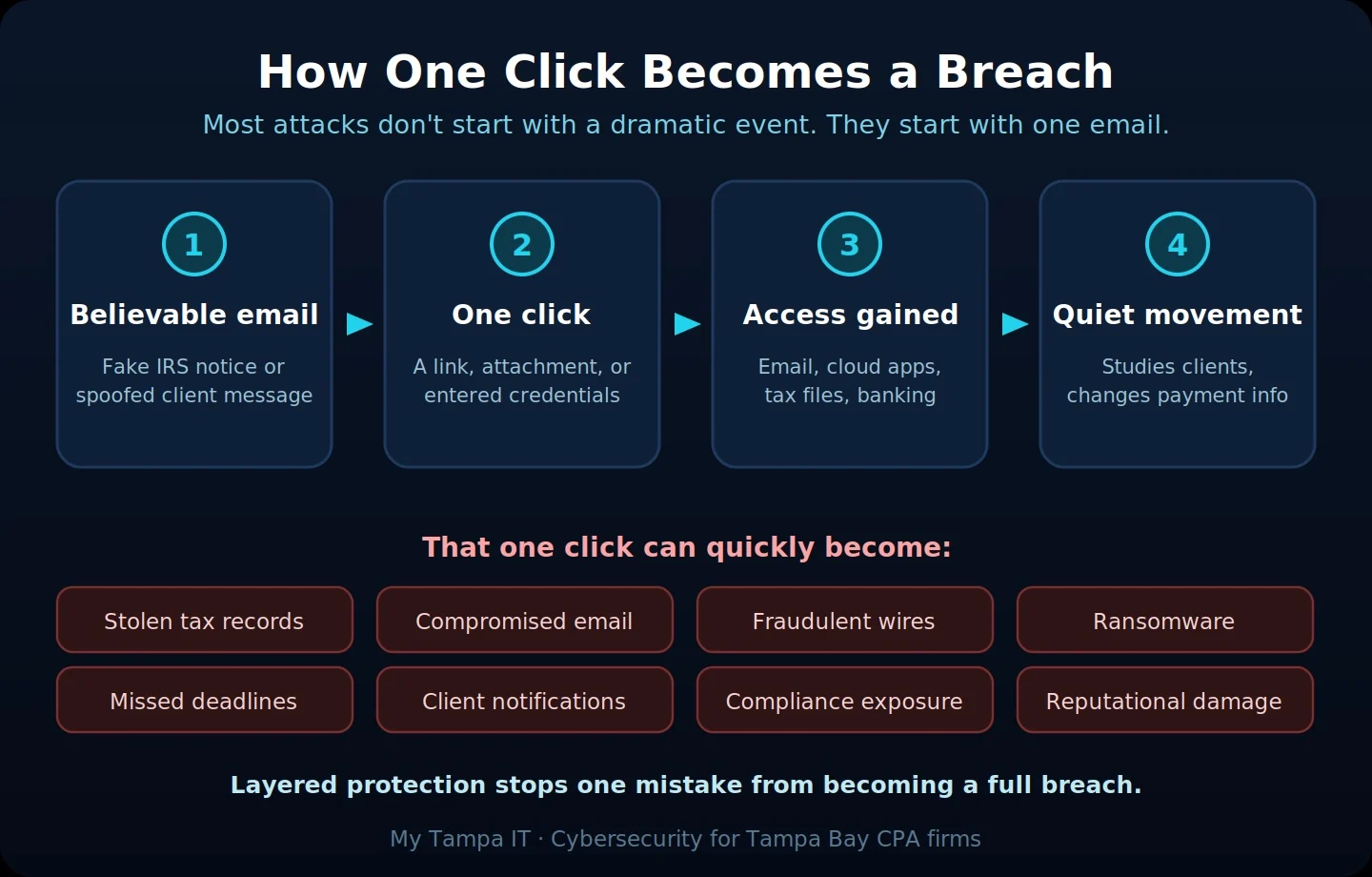
This is why CPA firms need layered protection. Email security, multi-factor authentication, endpoint protection, backups, employee training, and monitoring all work together so that one mistake never becomes a full breach.
The Biggest Cybersecurity Risks for CPA Firms
CPA firms face many of the same threats as other businesses, but the impact can be much greater because of the type of data they hold. These are the risks every firm should be watching closely in 2026. (What stops each of them comes later, in the protections section.)
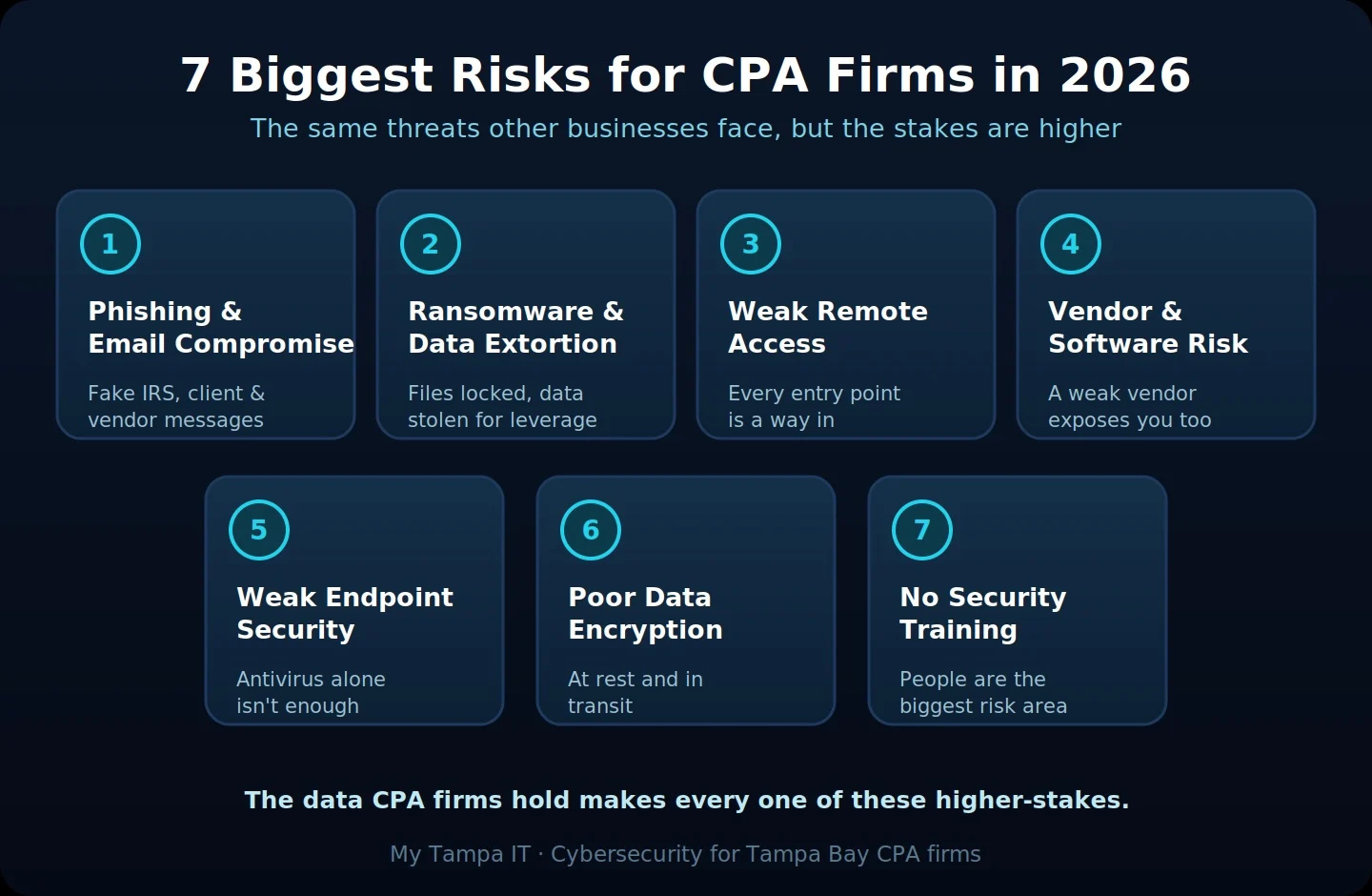
- Phishing and Business Email Compromise
Phishing is still one of the most common ways attackers get into a business. For CPA firms, the emails may appear to come from the IRS, a tax software provider, a client, a bank, a payroll company, or even someone inside the firm. The goal is usually to trick someone into clicking a malicious link, giving up login credentials, opening an infected attachment, or approving a fraudulent request.
Business email compromise is even more dangerous. In these attacks, a criminal gains access to a real email account and uses it to send convincing messages: requesting wire transfers, asking for tax documents, changing payment instructions, or impersonating a partner or client. Because the email comes from a real account, it can be very hard to spot.
- Ransomware and Data Extortion
In a ransomware attack, criminals lock or encrypt your files and demand payment to restore access. For a CPA firm, this can bring work to a complete stop, especially during tax season.
But ransomware has become even more dangerous. Many attackers now steal data before they encrypt it, then threaten to release sensitive client information if the ransom is not paid. This is called data extortion, and it creates a much bigger problem than downtime alone. Even with solid backups, you may still face client notification requirements, legal exposure, reputational damage, and difficult conversations with clients whose financial information may have been stolen.
- Weak or Unsecured Remote Access
Remote work is now normal for many accounting firms. Employees access firm systems from home, while traveling, or from client locations. That flexibility is helpful, but every remote access point is also a possible entry point for an attacker.
Common problems include weak passwords, no multi-factor authentication, personal devices touching firm data, unsecured home Wi-Fi, poorly configured VPN access, remote desktop services exposed to the internet, and no monitoring for unusual logins.
- Vendor and Software Risk
CPA firms rely on many third-party platforms: tax software, accounting systems, payroll tools, document management platforms, cloud storage, e-signature tools, CRM systems, and outsourced service providers. If one of those vendors has weak security, your firm may still be exposed, especially when a tool stores, processes, or has access to client data.
Before using a vendor, CPA firms should ask:
- What data will this tool access, and where is it stored?
- Is the data encrypted?
- Does the vendor require multi-factor authentication, and can access be limited by role?
- Does the vendor have security certifications or audit reports?
- How quickly will the vendor notify us if there is a breach?
- What happens to our data if we leave the platform?
Your firm can have strong internal security and still be exposed through a weak vendor.
- Weak Endpoint Security
Every laptop, desktop, tablet, and mobile device connected to your firm is an endpoint. If those devices are not properly protected, they can become an easy way in.
Common endpoint risks include unpatched software, outdated antivirus, employees using personal devices, local admin rights that are too broad, lost or stolen laptops, no device encryption, and no visibility into suspicious activity. Traditional antivirus is no longer enough on its own, which is why endpoint detection and response has become the baseline (more on that in the protections section).
- Poor Data Encryption Practices
CPA firms should protect sensitive data both when it is stored and when it is being sent. Data at rest is information stored on servers, laptops, backups, cloud platforms, or external drives. Data in transit is information moving through email, file sharing, portals, or other systems. If data is not encrypted, it may be readable if it is stolen, intercepted, or accessed by the wrong person.
Common gaps include unencrypted laptops, files shared through regular email, backups that are not encrypted, sensitive documents in unsecured folders, and external drives with no protection.
- Lack of Security Awareness Training
Technology matters, but people are still one of the biggest risk areas. Most cyberattacks depend on someone clicking, opening, approving, sharing, or trusting something they should not. That does not mean employees are careless. It means attackers are good at manipulation.
CPA firm employees should be able to recognize phishing emails, fake IRS notices, fraudulent client requests, suspicious attachments, fake login pages, payment-change scams, urgent wire transfer requests, AI-generated phishing, and other social engineering attempts.
Emerging Threats CPA Firms Should Watch
The attack techniques themselves are getting more sophisticated. In 2026, three are worth particular attention.
AI-Powered Phishing
AI has made phishing much harder to detect. Attackers can now create emails that sound professional and personalized: no spelling mistakes, a client’s tone mimicked, real business situations referenced, messages that look like normal communication. Employees can no longer rely on obvious red flags like poor grammar or strange wording, which raises the bar for both email security and verification habits.
Deepfake Voice and Video Fraud
Deepfake technology can imitate a real person’s voice or appearance. For CPA firms, that creates serious risk around payment approvals, wire transfers, tax documents, and urgent client requests. An employee may receive a call that sounds exactly like a partner or client asking for something urgent. The protection here is not just technical. Any request involving payment changes, wire transfers, sensitive documents, or credential access should be confirmed through a trusted second channel.
More Targeted Ransomware
Ransomware attackers are becoming more strategic. They research a firm before attacking, learn when deadlines occur, identify key people, and time the attack for maximum pressure, which makes tax season and other deadline-heavy periods especially risky. Strong security needs to be in place before the busy season, not scrambled together after something goes wrong.
Cybersecurity Risks with Outsourced Accounting Services
Many CPA firms use outsourced bookkeeping, tax preparation, administrative, or support services. These relationships can be helpful, but the more people and vendors who touch client data, the more important it becomes to control access and document security expectations.
CPA firms should make sure outsourced providers have clear data-handling procedures, role-based access, multi-factor authentication, secure file-sharing methods, written confidentiality expectations, documented security controls, breach notification procedures, and a process for removing access when work ends.
Outsourcing does not remove your firm’s responsibility to protect client data.
Essential Cybersecurity Protections for CPA Firms
Knowing the risks is half the picture. The other half is the handful of controls that actually stop them. CPA firms do not need security for the sake of security. They need practical protections that reduce real risk, working together as layers.
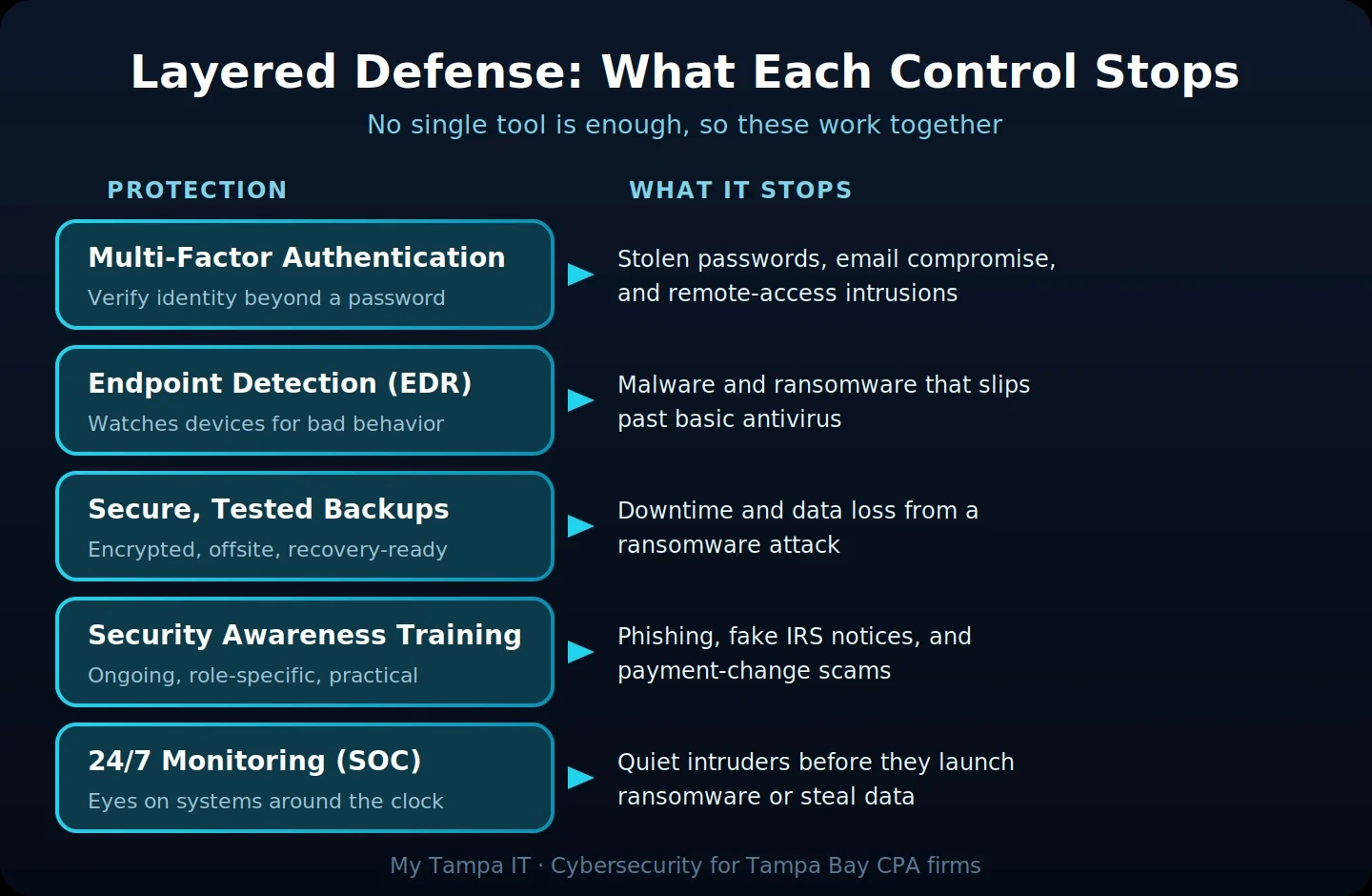
Multi-factor authentication (MFA) requires users to verify their identity with something more than a password, so a stolen password alone is not enough to get in. For CPA firms it should not be optional, and it should cover email, cloud applications, tax software, remote access, client portals, banking and payroll systems, and admin accounts.
Endpoint detection and response (EDR) goes beyond traditional antivirus by watching devices for behavior that signals an attack in progress. If a device starts acting strangely, EDR can isolate it before the threat spreads, which matters most for firms with remote workers, multiple offices, seasonal staff, or sensitive files spread across devices.
Secure, tested backups are critical, but only if they are encrypted, stored securely, protected from ransomware, kept offsite or in a secure cloud environment, and, most importantly, tested. A backup that has never been tested is just a hope. Know how long it would take to restore critical systems and whether you could keep operating if email or tax software went down.
Ongoing security awareness training should be easy to understand and tied to the work: tax-season examples, client requests, document sharing, payment changes, fake IRS notices. The goal is not to scare employees; it is to help them pause before clicking, sharing, approving, or responding. This works far better as a continuous habit than a once-a-year checkbox.
24/7 monitoring through a Security Operations Center (SOC) watches systems around the clock. Because many attacks begin quietly (criminals often spend time inside a system before launching ransomware or stealing data), the faster a threat is detected, the better the chance of limiting the damage.
CPA Firm Compliance Requirements
For CPA firms, protecting client data is not only good practice. Much of it is required by law, professional standards, insurance carriers, and client contracts.
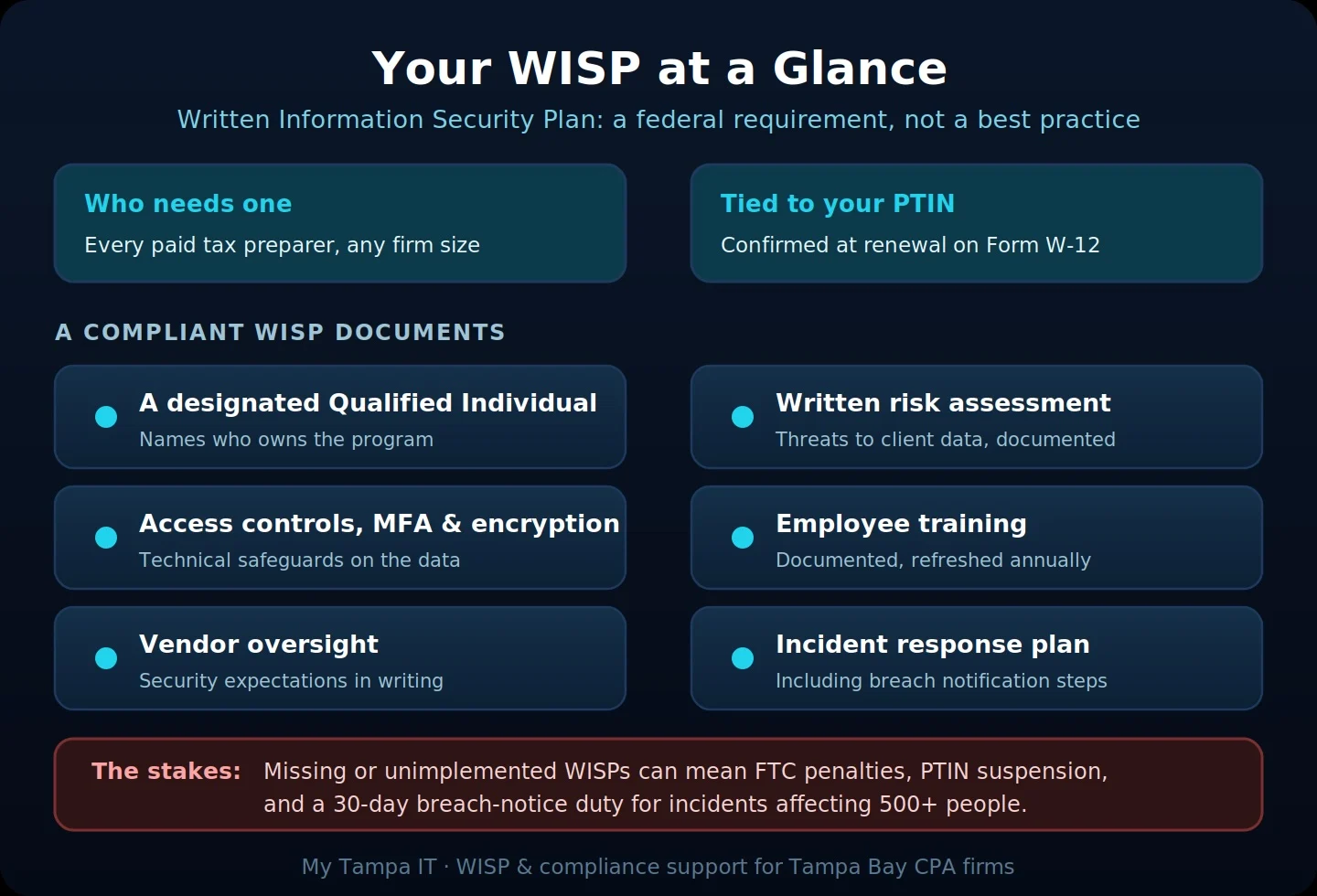
The WISP Requirement Is Not Optional
Under the FTC Safeguards Rule (16 CFR Part 314) and IRS Publication 4557, every paid tax preparer who handles taxpayer data is required to maintain a Written Information Security Plan (WISP), regardless of firm size. A solo practitioner and a 50-person firm are held to the same baseline. Since 2023, confirming that you have a data security plan is part of PTIN renewal on Form W-12, so this is no longer something a firm can quietly skip.
Because tax preparation is treated as a financial activity under the Gramm-Leach-Bliley Act, the FTC considers your firm a financial institution. The Safeguards Rule requires specific, enforceable controls: a designated qualified individual to run the program, a written risk assessment, access controls, encryption, multi-factor authentication, employee training, vendor oversight, and a documented incident response plan. It also carries a 30-day breach-notification requirement to the FTC for incidents affecting 500 or more people.
The stakes are real. A missing or unimplemented WISP can expose your firm to FTC enforcement and civil penalties, and the IRS can suspend the PTIN you need to file returns. A WISP should not be a generic document sitting in a folder. It should reflect how your firm actually operates, and it should be reviewed and updated as your firm changes.
It should reflect how your firm actually operates, and it should be reviewed and updated as your firm changes. If you want a deeper walkthrough of these obligations, we break down the updated FTC Safeguards Rule for CPAs and what it means for your firm in a separate guide.
State Privacy Laws
Regardless of firm size, is the Florida Information Protection Act (FIPA) requires reasonable safeguards for Floridians’ personal information and notification within 30 days of a breach, with penalties for failing to report. CPA firms may also be affected by other states’ privacy laws, depending on where their clients live and what information the firm handles. This gets complicated for firms serving clients across multiple states. Even where a specific law does not apply directly, strong data protection reduces risk and shows clients that security is taken seriously.
Cyber Insurance and Client Expectations
Cyber insurance carriers are asking tougher questions than they used to. Many now expect controls such as MFA, EDR, backups, employee training, access controls, and an incident response plan before they will issue or renew a policy, and after a breach they audit your program before paying a claim. A growing number of clients are also asking about cybersecurity before they share sensitive information or sign an agreement. Strong security now supports your insurance, your compliance, and your credibility all at once.
What’s Changing for CPA Firms in 2026
Beyond the threats themselves, the environment around CPA firms is shifting in ways that raise the stakes:
- Cyber insurance requirements are getting stricter, with more controls demanded up front.
- Regulators are paying closer attention to how firms protect data.
- Clients are more aware of cybersecurity risk and more likely to ask about it.
- Remote work and cloud tools keep expanding the attack surface.
- AI and automation tools are entering everyday firm work, raising new questions about what client data can safely go into them and how to adopt them securely.
- Vendor relationships are growing, which makes third-party risk harder to manage.
The firms that do best will be the ones that treat cybersecurity as an ongoing business function, not a one-time project.
Why This Matters for Tampa Bay CPA Firms
For CPA firms in Tampa Bay, cybersecurity is becoming part of client confidence. Business owners and individuals are more aware of data risk than they used to be, and they want to know their accountant is protecting the tax records, financial statements, payroll data, bank details, and personal identification they share.
In a relationship-driven business community like Tampa Bay, reputation matters. A cybersecurity incident can affect more than systems and files. It can affect referrals, client retention, and professional credibility. That is why strong security belongs in your client service model, not just your IT closet.
Protecting Your CPA Firm with Proactive IT and Cybersecurity Support
CPA firms need more than reactive IT support. They need systems that are monitored, updated, secured, backed up, and reviewed regularly. They need employees who know what to watch for. And they need a plan for protecting client data before something goes wrong.
That is where My Tampa IT can help. We help CPA firms and other professional service businesses reduce cyber risk, improve productivity, and protect the sensitive data their clients trust them with.
Our team can help with:
- Managed IT support
- Cybersecurity risk assessments
- Secure AI and automation implementation
- Multi-factor authentication
- Endpoint detection and response
- 24/7 security monitoring
- Secure backups and disaster recovery
- Microsoft 365 and email security
- Employee security awareness training
- Vendor risk review
- WISP and compliance support
Cybersecurity is not about checking a box. It is about protecting your firm, your clients, your reputation, and the trust you have worked hard to earn.
If your CPA firm wants to strengthen security and/or put the right guardrails around new AI tools before the next busy season, schedule a consultation with us.
Frequently Asked Questions
Yes, with the right guardrails. The main risk is staff pasting client information into public AI tools that have not been reviewed for security or confidentiality. A short acceptable-use policy that defines approved tools, what data is off limits, and who reviews AI output lets your firm capture the efficiency without exposing client data. These rules fit naturally inside your WISP, and they are exactly what a secure AI and automation rollout is designed to put in place.
Not automatically. Many carriers now require controls such as multi-factor authentication, endpoint detection, tested backups, training, and an incident response plan before they will issue a policy, and after a breach they often review whether those controls were actually in place. If the program you described on your application does not match reality, a claim can be reduced or denied. Strong, documented security helps protect both your data and your coverage.
For practical purposes, yes. The FTC Safeguards Rule requires multi-factor authentication on systems that store client information, and cyber insurance carriers increasingly expect it before they will issue or renew a policy. It should cover email, cloud applications, tax software, remote access, client portals, and banking and payroll systems, not just a few accounts.
Usually with one believable email rather than a dramatic technical break-in. A fake IRS notice, a spoofed client message, or a routine-looking document request during tax season is enough for someone to click a link, open an attachment, or enter credentials. From there an attacker can reach email, cloud apps, tax files, and banking details. This is why email security, multi-factor authentication, and ongoing training matter so much.
Yes. A WISP is a federal requirement under the FTC Safeguards Rule and IRS Publication 4557 for any paid tax preparer who handles taxpayer data, regardless of firm size. Since 2023, confirming you have one is part of PTIN renewal on Form W-12, so a solo practitioner and a 50-person firm are held to the same standard. It needs to be written, implemented, and kept current, not a generic template sitting in a drawer.
Get In Touch!
You’ve got questions. We’ve got answers.
Let’s start the conversation about your IT support needs.